Plinko Online in Australia: Free Demo Play and Real Money Guide

Last updated: February 2026 | Written and fact-checked by Claire Bennett, Senior Casino Content Editor | For adult readers only (18+)

"A responsible casino review begins long before you look at headline bonuses or high max multipliers. In digital gambling games like Plinko, understanding mathematical probabilities, provider volatility settings and the strict Australian regulatory framework is essential before placing a single stake." Claire Bennett, Senior Casino Content Editor.

Plinko Online in Australia Free Demo

Quick Takeaways

  • Plinko is pure chance. Every ball drop is governed by an RNG or Provably Fair algorithm. No system, pattern or "hot slot" tracker can influence where the ball lands.
  • The maths is a Galton board. Central multiplier pockets are hit most often and pay the least (0.2x to 0.9x); edge pockets are statistically rare, which is exactly why they carry the headline multipliers (up to 1,000x, or 10,000x in some variants).
  • RTP looks generous, but it varies wildly. Published figures run from 99.00% (BGaming, Stake Originals) down to 88.20% in the lowest RTP band configured for Hacksaw Gaming's Plinko. Always confirm the active RTP tier in the game's info panel.
  • Legality comes first. Under the Interactive Gambling Act 2001 (Cth), supplying real-money online casino games to people in Australia is prohibited. Read the legal section below before the step-by-step play guide.
  • Demo mode is a testing tool, not entertainment. Free play should be used to inspect volatility, then closed. Simulated gambling is linked in peer-reviewed research to later monetary betting and harm.
Quick Takeaways. - Plinko is pure

The Editorial Verdict at a Glance

This guide is terms-first by design. Before any multiplier or bonus gets discussed as a benefit, we check the boring material: legality for Australian residents, licensing, RTP disclosure, withdrawal rules and safer-gambling tooling. That order is deliberate.

What we weigh when reviewing a Plinko game or the brand hosting it:

  • Legal position for Australia under the Interactive Gambling Act 2001, stated plainly rather than buried.
  • Active RTP band, verified inside the client, not copied from a marketing page.
  • Volatility settings and how far the probable outcome sits below the advertised ceiling.
  • Bonus weighting for Plinko wagers, plus max bet caps and expiry windows.
  • Withdrawal friction: minimums, fees, processing times and KYC documents.
  • Player protection: deposit caps, loss limits, reality checks, time-outs, self-exclusion.
  • Complaint history and escalation route beyond the operator's own support desk.

Verdict in one line: Plinko is mechanically simple, mathematically transparent and behaviourally risky, and the real-money version sits inside a restricted legal environment for Australian residents.

Plinko is a chance-based online casino game inspired by the classic pegboard design, popularised by television game shows and Galton board physics. A virtual ball drops through a triangular grid of pegs into multiplier slots at the bottom. Australian adult players evaluating Plinko online can choose between risk-free demo modes for testing the mechanics and real-money modes offered on licensed platforms. Understanding how row configurations, provider-specific Return to Player (RTP) models and volatility settings dictate outcomes is crucial before engaging with any commercial offer.

The wider context matters, too. Interest in fast, casino-style online products has grown sharply across Australia in recent years, and so has measured risk.

The Editorial Verdict at a Glance

"Australians gambling at risky levels rose from 11.6% to 13.6% across 2023–2024, while online gambling grew exponentially to become one of the leading platforms." Gambling Participation in Australia 2024, Australian National University.

What is Plinko and How Does the Game Work?

In short: a ball falls through rows of pegs and lands in a multiplier pocket; the pocket value multiplies your stake. Outcomes follow binomial probability, not skill.

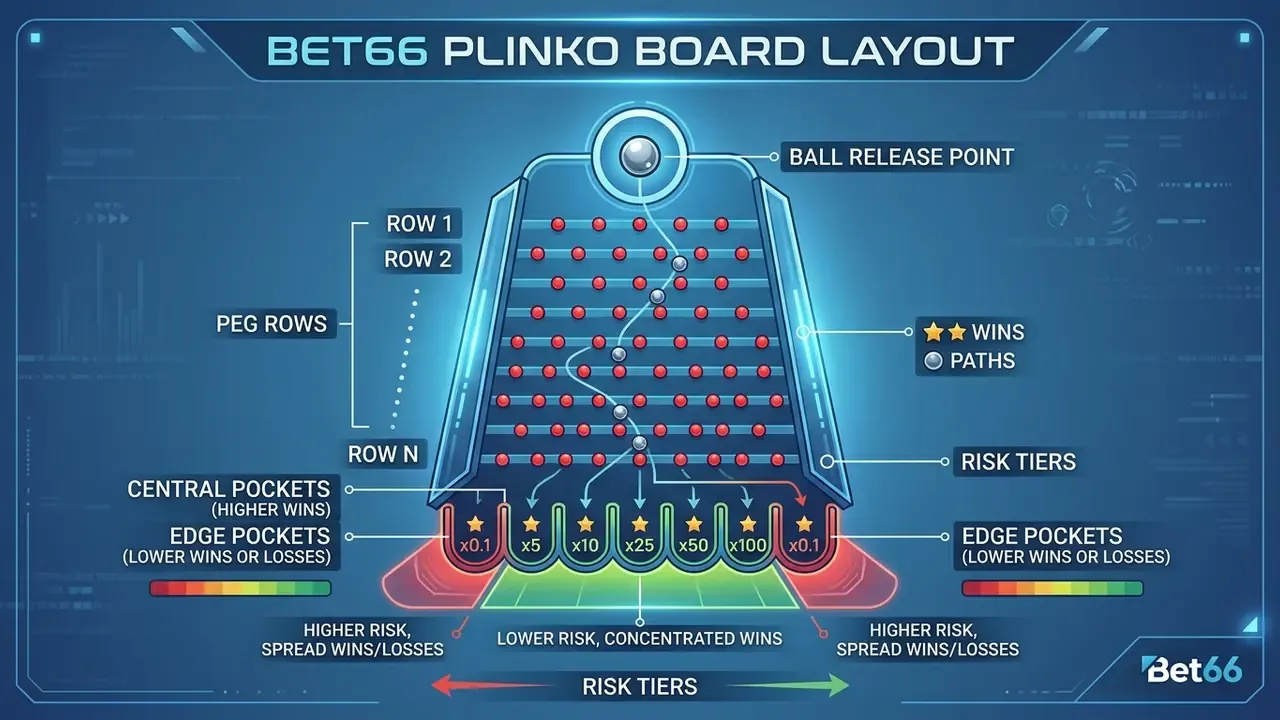
Plinko is an interactive digital casino game in which a ball is released from the top of a triangular field filled with rows of pegs. It bounces randomly left or right until it settles in a multiplier compartment at the base. Every round operates on a Random Number Generator (RNG) or a Provably Fair algorithm, so the ball's final landing slot is determined entirely by probabilistic distribution rather than player skill. The core payout mechanic is simple: your stake is multiplied by the coefficient attached to the pocket where the ball comes to rest.

The gameplay relies on the mathematics of the Galton board. As the ball hits each peg on its descent, that peg offers a roughly 50/50 trajectory choice. Because there are far more paths leading to the centre of the board than to the extreme edges, central slots are hit much more frequently and offer lower multiplier values, often below 1x. Outer edge slots have a far lower probability of occurrence, which is precisely why operators attach the biggest prizes to them (100x, 500x, 1,000x and beyond).

Provably Fair implementations add a verification layer on top of that maths. Each drop is generated from a combination of server seed and client seed, and the hashed seed can be checked after the round to confirm the result was not altered mid-flight. This does not improve your odds. It only proves the published distribution was respected.

What is Plinko and How Does
Plinko game: board layout and multiplier distribution

Purpose: helps the reader visually grasp the ball's trajectory, the shape of the binomial distribution, and the difference between central and edge pockets. Semantics: image block with caption and alt text "Plinko game: board layout and multiplier distribution". All schematic labels are duplicated as plain text on the page for accessibility.

Rows, Risk Profiles and Multipliers

In short: rows control how wide the probability curve becomes; risk level controls how aggressively multipliers are shifted from the centre out to the edges.

Adjusting the number of rows, typically between 8 and 16, reshapes the game's probability pyramid. It changes both the total number of landing slots and the spread of multiplier coefficients. Select a lower row count, say 8 rows, and the variance narrows: lower maximum payout caps, more predictable landing distributions. Expand the board to 16 rows and you add bounce decisions, which flattens the central bell curve and stretches the theoretical maximum multipliers on the far edges.

Risk levels, usually labelled Low, Medium (or Normal) and High, reallocate how multipliers are assigned across those available slots. Under a Low risk setting, central slots usually return a substantial portion of the stake, roughly 0.5x to 0.9x, while edge multipliers stay modest at about 5x to 16x. Under a High risk setting, central multipliers drop sharply, often to 0.2x, and the board compensates by lifting edge payouts up to 1,000x or higher.

Updated evidence on volatility and harm. Choosing high-risk configurations sharply increases session volatility, which can accelerate bankroll depletion during extended dry runs. That is not just a design observation. Population research links high-volatility, large-jackpot products to disproportionate harm:


Rows, Risk Profiles and Multipliers. In

"High-volatility, large-jackpot products, online casino games and EGMs, are leading sources of harm in New South Wales despite smaller participation shares." NSW Gambling Survey 2024, Central Queensland University / Ipsos Australia.

Full Plinko Multiplier Reference Table (8 to 16 Rows)

The grid below reflects the most widely deployed coefficient sets across major Plinko builds. Exact values differ slightly by provider and by operator configuration, so cross-check the in-game paytable every time.

Active Peg RowsLow Risk Multipliers (Centre to Edge)Medium Risk Multipliers (Centre to Edge)High Risk Multipliers (Centre to Edge)
8 Rows0.5x to 5.6x0.4x to 13.0x0.2x to 29.0x
9 Rows0.7x to 5.6x0.5x to 18.0x0.2x to 43.0x
10 Rows0.5x to 8.9x0.4x to 22.0x0.2x to 76.0x
11 Rows0.7x to 8.4x0.5x to 24.0x0.2x to 120.0x
12 Rows0.5x to 10.0x0.3x to 33.0x0.2x to 170.0x
13 Rows0.7x to 8.1x0.4x to 43.0x0.2x to 260.0x
14 Rows0.5x to 7.1x0.2x to 58.0x0.2x to 420.0x
15 Rows0.7x to 15.0x0.3x to 88.0x0.2x to 620.0x
16 Rows0.5x to 16.0x0.3x to 110.0x0.2x to 1,000x

Read the table as a risk trade-off, not as a menu of opportunities. Moving from 8 rows on Low risk to 16 rows on High risk multiplies the theoretical top prize roughly 2,000-fold. At the same time it pushes the most probable outcome down to 0.2x, meaning the statistically typical drop hands back about twenty cents on the dollar. That is the trade nobody advertises.

[LAYOUT WIDGET: Plinko Multiplier and Volatility Simulator]

  • User input:select Rows (8 to 16) and select Risk (Low, Medium, High).
  • Dynamic output:minimum payout, maximum payout, central-hit probability (%), and a theoretical session volatility rating.
  • Purpose:lets readers model expected variance before wagering, instead of discovering it with real funds.
Bet66 heading-banner

Plinko Demo Mode vs Real Money Gameplay

In short: demo credits carry zero financial risk and zero withdrawal rights; real-money play triggers KYC, bonus terms and genuine loss exposure.

Plinko demo modes use virtual credits so players can inspect gameplay, row settings and risk profiles without financial exposure. Real-money play involves actual monetary stakes, real payout risk and strict licensing controls. The free-play environment is built purely for educational inspection: it runs on simulated balances that cannot be converted into cash withdrawals or used to satisfy promotional rollover conditions. Real-money play connects directly to a player's balance, where outcomes hit real funds and trigger mandatory operator compliance obligations under applicable law.

Plinko Demo Mode vs Real Money
ParameterPlinko Demo / Free ModeReal Money Plinko
Financial StakeVirtual credits (no monetary value)Real funds (AUD or supported crypto/currencies)
Monetary RiskZero financial lossFull risk of stake loss per drop
Withdrawal CapabilityNon-withdrawable virtual balancesWithdrawable real winnings (subject to KYC and T&Cs)
Casino Bonus EligibilityNot eligible for promotional offersQualifies for deposit matches, free spins and cashback
Regulatory and Age ChecksOften accessible without full KYCStrict 18+ age verification and identity checks
Psychological ImpactLow emotional pressureHeightened risk sensitivity and potential chasing behaviour
AvailabilityUsually no registration or deposit requiredAccount, funding method and jurisdictional eligibility required

The operational gap between free demo testing and real-money engagement comes down to regulatory oversight and financial stakes. Free Plinko is an ideal testing environment for inspecting provider volatility, yet peer-reviewed evidence shows the transition risk is real:

"Lifetime participation in simulated gambling, including demo games, is associated with monetary gambling and harm even after adjusting for demographics and impulsivity." Hing et al. (2023), "Order of first-play in simulated versus monetary gambling", Journal of Behavioral Addictions.

So treat demo modes strictly as informational tools rather than endless entertainment, and close the session once you have seen how the board behaves. Fifteen minutes is usually enough.

Our own testing experience. When we assess how iGaming operators present demo modes alongside real-money offerings, auditing the fine print and the compliance structure becomes the main job. In one editorial review project covering brand transparency across our Australian English comparison pages, our team examined a large sample of interactive game interfaces to check whether the parameters advertised in demo builds matched the mathematical models served in real-money mode. Methodology and the full brand list are documented on our iGaming analytics hub, where we cross-reference published RTP tables against in-client paytables and require explicit risk disclosures. That process surfaced two recurring problems: demo builds displaying a higher RTP tier than the live version, and promotional pages omitting game-weighting rules. Both create misleading expectations before account creation, which is why we publish plain risk warnings alongside every comparison.

So treat demo modes strictly as

Why You Should Start with Free Demo Mode

Starting with a free Plinko demo lets you evaluate the game physics, test row configurations and feel the volatility swings without exposing capital. Demo mode is a practical sandbox: you can watch how often the ball lands in low-paying central compartments compared with high-paying side slots across hundreds of drops. That hands-on look sets realistic expectations about payout frequency and defuses the common belief that big edge multipliers turn up regularly in normal play. They do not.

Practical checkpoints while you are in demo mode:

  • Drop at least 100 balls on one setting and count how many results returned less than your stake.
  • Switch from 8 rows to 16 rows and note how much longer the dry streaks become on High risk.
  • Confirm the interface exposes an autoplay stop-loss and a visible balance counter.
  • Check whether the info panel discloses an RTP figure at all. If it does not, treat that as a red flag.
Why You Should Start with Free

Key Changes When Switching to Real Money Stakes

Real-money Plinko introduces direct financial exposure. Every drop deducts real currency from your account balance and returns withdrawable value based on the published paytable. Real-money play also brings in external variables: casino deposit limits, withdrawal verification (KYC) requirements, and promotional bonus wagering conditions. Actual monetary risk changes player psychology as well. The emotional response to a losing streak or a near-miss on an edge pocket can trigger impulsive stake escalation, which is exactly why strict personal deposit caps and session timers should be in place before the first paid wager, not after it.

Key Changes When Switching to Real

Alternative Gameplay: Sweepstakes and Social Plinko Platforms

In markets where traditional real-money online casinos operate under regulatory restrictions, players often run into sweepstakes or social casino platforms instead. These services use a dual-currency model:

  • Gold Coins (GC): purely virtual tokens for free entertainment play, with no monetary value and no redemption pathway.
  • Sweeps Coins (SC): promotional tokens obtained through bonuses, purchase bundles or mail-in requests, playable on Plinko titles and redeemable for cash prizes or gift cards once playthrough conditions are met, commonly 1x to 3x.

Sweepstakes models are not a universal legal workaround, and availability is geographically restricted. Terms, eligible states or territories, redemption minimums and identity checks all vary by operator, so read the promotional rules in full. One point gets overlooked: social play with virtual currency still runs on the same volatility mechanics, and buying coin packages is real expenditure even when the coins themselves carry no cash value.

Alternative Gameplay Sweepstakes and Social Plinko

In short: supplying real-money online casino games to Australian residents is prohibited, ACMA actively blocks offending sites, and BetStop covers licensed wagering self-exclusion.

Before evaluating any offer, Australian readers should understand where the law sits. Under the Interactive Gambling Act 2001 (Cth), offering real-money online casino services to people residing in Australia is prohibited. Enforcement is not theoretical:

Self-exclusion infrastructure exists for licensed wagering products, and plenty of Australians use it:

Who Should Skip Plinko Entirely

Plinko rounds are measured in seconds, and many builds let you launch several balls at once without waiting for the previous drop to resolve. That mix of speed and repeatability makes the format a poor fit for some players. Consider avoiding it altogether if you:

  • have previously chased losses on fast-cycle products such as crash games, EGMs or roulette;
  • are currently registered with BetStop, a state self-exclusion scheme, or an operator-level exclusion;
  • would be gambling with money allocated to rent, groceries, debt repayments or credit;
  • feel urges to increase stakes after losing streaks, or struggle to stop a session at a pre-set limit;
  • are under 18, or are researching on behalf of someone who is;
  • experience low mood, stress or intoxication that impairs decision-making during play.

If any of that applies, free support is available in Australia through Gambler's Help on 1800 858 858 (24/7) and BetStop for licensed wagering exclusion.

Who Should Skip Plinko Entirely. Plinko

How to Play Plinko Online: Step-by-Step

In short: verify legality and licensing first, set hard limits second, test in demo third, and only then consider a minimal real-money stake.

Launching Plinko online responsibly means selecting an accredited operator, understanding jurisdictional restrictions, establishing personal limits and configuring the game settings before you place a wager. A structured sequence keeps the checks in the right order, so licensing and bonus conditions get inspected before any funds move.

1
Verify platform licensing and legality. Confirm the online casino holds valid licensing, publishes transparent terms of service, and meets the consumer-protection and safer-gambling expectations relevant to your jurisdiction. Re-read the legal section above before going further.
2
Complete account registration and identity checks. Register using accurate personal details and complete the required age verification (18+) and KYC procedures mandated under anti-money laundering (AML) guidelines.
3
Inspect promotional terms and wagering rules. Before opting into any welcome bonus or deposit offer, read the fine print: wagering requirements, max bet caps, expiry dates, and whether Plinko wagers contribute 100% toward rollover. Many operators weight the game at only 5% to 10%, or exclude it outright.
4
Establish responsible gambling limits. Use account settings to apply daily, weekly or monthly deposit limits, loss caps and session time reminders before your first deposit lands.
5
Launch Plinko in demo mode first. Open the game interface in free-play mode and test row counts (8 to 16) and risk levels (Low, Medium, High) to confirm how the interface handles bets and autoplay stops.
6
Set stake size and risk parameters for real play. Switch to real-money mode, drop the bet amount to a small fraction of your session bankroll, finalise row and risk settings, then release the ball.

Pre-Deposit Safety Checklist

  • Licence number is published and verifiable on the regulator's own register.
  • RNG or Provably Fair certification from a recognised lab (eCOGRA, iTech Labs, GLI) is displayed.
  • The in-game info panel shows the active RTP tier, not just a marketing figure.
  • Deposit, loss and session limits can be set before funding the account.
  • Withdrawal minimums, fees, processing times and document requirements are stated in writing.
  • Bonus terms disclose the wagering multiple, max bet during rollover, expiry and Plinko game weighting.
  • Self-exclusion, time-out and reality-check tools are one click from the account menu.
  • Support channels (live chat or email) answer before you deposit, not after.
Pre-Deposit Safety Checklist. - Licence number

Setting Stakes, Risk Levels and Initiating Drops

To configure a Plinko round, you choose a base stake, adjust the number of active peg rows, pick a risk setting, then decide between manual or automated launching. In manual mode each click releases a single ball, which gives complete control over betting velocity and lets you read each result. In auto-play mode you set a predefined number of drops plus automated stop limits, for example stopping if a single win exceeds a threshold or if the balance falls by a set percentage. Those stops matter, because they keep the software from executing unchecked bets while your attention drifts.

Colour-coded launch controls. In some interfaces, notably Spribe's Plinko Classic, bet execution runs through three distinct launch buttons rather than a single generic bet button:

Setting Stakes, Risk Levels and Initiating
  • Green button (low volatility):releases a ball into a tight-variance multiplier row, with central pockets paying close to the base stake and edge pockets offering modest boosts, roughly 0.5x to 18x, up to about 35x on wider boards.
  • Yellow button (balanced risk):central pockets pay slightly less, while mid-to-outer pockets scale up substantially, up to roughly 55x to 118x.
  • Red button (high volatility):central pockets return minimal value, as low as 0.2x, but the outermost pockets carry maximum exposure, up to 555x on a 16-row Spribe board.
Bet66 heading-banner

Many builds also include a results record table that logs recent drops and flags "hot" or "cold" pockets. Treat it purely as a session log. Because each drop is independent, a pocket that has not been hit for 200 rounds is no more likely to land on round 201. The board has no memory. You might, which is the actual danger.

Plinko RTP Models, Volatility and Payout Structures

In short: headline RTP figures of 97% to 99% are real but tiered, so the same title can ship in a much weaker configuration. Verify the active band before you stake.

Return to Player (RTP) in online Plinko generally sits between 96% and 99% depending on the software provider, yet a high mathematical return rate does not remove short-term volatility or the statistical likelihood of net losses. An RTP of 98% theoretically means $98 flows back to players for every $100 wagered across millions of drops. Individual sessions swing wildly around that figure based on the chosen risk configuration and row depth. High RTP values simply describe a low house edge over an effectively infinite sample; they guarantee nothing across an hour of play.

Plinko RTP Models, Volatility and Payout

Fact Check and Rule Verification: Independent testing agencies such as eCOGRA, iTech Labs or GLI certify that Plinko RNG software produces mathematically random outcomes aligned with published paytables. RTP configurations can still vary by software provider and operator tier. Players must check the in-game information panel or paytable inside their specific casino interface to verify the active RTP, maximum multiplier limits and payout caps before playing.

Statistical Probability of Extreme Outcomes

When you set high-volatility parameters, such as Hacksaw Gaming's 16-row High risk mode, account for the underlying distribution rather than the advertised ceiling. Hitting that build's maximum 3,843.3x multiplier carries a stated hit probability of 1 in 32,768 drops. Put in dollars: at $1 per ball, roughly $32,768 of turnover would pass through the game before that outcome is expected to appear once, and expectation carries no timetable. It may never happen across a lifetime of play.

Operators can also configure variable RTP bands for the same title. Hacksaw's Plinko is documented across seven tiers: 98.98% | 98.28% | 97.27% | 96.02% | 94.30% | 92.03% | 88.20%. The gap between the top and bottom band exceeds ten percentage points of house edge. Which is why checking the active tier in the game settings menu matters far more than comparing marketing claims between brands.

RTP and multiplier disclaimer. RTP figures and maximum multipliers depend on the specific provider and the build deployed by each operator. Check current values in the game's information panel on your chosen platform. This information is general in nature and does not replace professional advice.

Different vendors build unique mathematical frameworks for their Plinko titles. The figures below come from provider documentation and independent game databases; treat them as indicative and verify in-client:

  • BGaming Plinko:adjustable rows (8 to 16) and three risk levels (low, normal, high), with an RTP of up to 99% and a maximum payout multiplier capped at 1,000x on High risk with 16 rows. Includes Manual and Auto bet modes plus a results record board, and runs on Provably Fair verification.
  • Spribe Plinko Classic:uses a colour-coded ball system (Green, Yellow, Red) mapped to different risk tiers, with an RTP of roughly 97%, adjustable 12/14/16 peg rows, a 555x maximum win and lower overall variance. No bonus rounds and no gamble feature.
  • Hacksaw Gaming Plinko:custom high-volatility profiles with extreme edge multipliers reaching 3,843.3x, stakes from 0.10 to 100 per drop, Low/Medium/High risk across 8 to 16 rows, a documented max-win probability of 1 in 32,768, and RTP bands from 98.98% down to 88.20%. Players can release multiple balls without waiting for the previous drop to land.
  • Stake Originals Plinko:a crypto-first implementation with custom Provably Fair seed verification, 8 to 16 rows, an RTP of 99% and a 1,000x top multiplier on maximum settings.
Bet66 heading-banner
Game TitleSoftware DeveloperTheoretical RTPMax Multiplier CapDistinctive Feature
PlinkoBGaming99.00%1,000xHighly customisable 8 to 16 row layout, Manual/Auto modes, Provably Fair
Plinko ClassicSpribe97.00%555xThree-tier colour-coded ball selection (Green, Yellow, Red)
PlinkoHacksaw Gaming88.20% to 98.98%3,843.3xHigh variance, 1 in 32,768 max-win probability, multi-ball launching
Plinko XSmartSoft Gaming97.00%10,000xHigh-multiplier bonus drops, vivid arcade presentation, strong mobile build
Pine of PlinkoPrint Studios96.48%10,000xIntegrated bonus round triggered by mechanical peg features
Plinko XYBGaming99.00%16xUltra-low ceiling, very tight variance for extended low-risk sessions

The spread here is instructive. Two titles share a 10,000x ceiling yet sit almost three percentage points apart on RTP, while Plinko XY pairs a 99% return with a 16x cap. Maximum multiplier and long-run return are independent variables, so a bigger headline number does not make a better game for your bankroll.

Plinko Strategy and Bankroll Control: What Actually Helps

In short: no staking system beats the house edge. The only controllable variables are stake size, session length and stopping discipline.

There is no betting strategy, mathematical system or software trick that overcomes the house edge or produces consistent profit in Plinko. Because every drop is an independent probabilistic event governed by random algorithms, approaches such as Martingale (doubling bets after a loss) or rapid risk-level switching leave the underlying odds untouched. They only redistribute risk across your bankroll, usually speeding up how fast capital disappears during a bad run. Some competitor guides still recommend Martingale for Plinko. That advice is mathematically unsound: table limits and finite bankrolls guarantee the doubling sequence eventually breaks, and no sequence of stakes changes the probability of the next drop.

Plinko Strategy and Bankroll Control What

Alert: absolute randomness and financial risk Plinko outcomes are generated by Random Number Generators (RNG) or cryptographic Provably Fair algorithms. No strategy, pattern-tracking or timing method can predict or influence where the ball lands. Gambling should never be treated as a source of income or a way to recover losses. Only wager funds you can afford to lose completely, and keep strict personal limits in place at all times.

Responsible stake management in Plinko is about harm minimisation, bankroll preservation and session discipline:

  • Fixed fraction staking:keep individual drop wagers below 1% to 2% of your allocated entertainment budget so ordinary volatility does not wipe the session.
  • Match risk to your volatility goals:choose Low risk if you prefer longer sessions with frequent small partial returns; pick High risk only if you genuinely accept rapid drawdowns while chasing rare edge multipliers.
  • Pre-set loss and win limits:define hard boundaries before you launch, for instance ending the session after losing 20% of your bankroll or after hitting a target win coefficient.
  • Cap session duration, not only spend:Plinko rounds resolve in seconds, so twenty minutes can produce hundreds of wagers. Set a clock limit next to your money limit.
  • Never chase losses:do not raise bet sizes or jump to High risk to recover earlier losses. Qualitative research is blunt about how quickly this escalates on mobile:
Bet66 heading-banner

"Smartphone betting encourages loss chasing, riskier bets and impulsive decisions, particularly among young adults with immediate mobile access." Hing et al. (2024), "'Immediate access … everywhere you go': a grounded theory study" (qualitative study, 33 Australians aged 18 to 29).

Bonus Wagering: A Worked Plinko Example

Game weighting is where Plinko bonuses quietly turn unattractive. Assume a $100 bonus with a 35x wagering requirement:

ScenarioGame WeightingRequired TurnoverEffective Cost
Bonus played on eligible pokies100%$3,500Baseline
Bonus played on Plinko10%$35,00010 times more turnover
Bonus played on Plinko5%$70,00020 times more turnover

At 5% weighting, every $1 staked on Plinko contributes just five cents toward the requirement, so clearing a $100 bonus demands $70,000 in turnover. Even at 99% RTP, expected losses across that volume dwarf the bonus value. Many operators also cap the maximum bet during rollover or exclude Plinko from bonus play entirely. Find the weighting table before opting in, not after.

Plinko Mobile Play, Downloads and App Compatibility

In short: HTML5 browser play delivers identical maths with no download, though constant mobile access is itself a documented risk factor.

Online Plinko is fully optimised for mobile devices through native HTML5 browser compatibility, so no standalone software download or app installation is needed on iOS or Android. Mobile browsers render the vector graphics, peg animations and interactive controls cleanly, resizing the triangular board to touch-screen dimensions without hurting functionality or load speed. The plinko mobile experience is, in practice, the same game with bigger buttons.

Some licensed operators do offer dedicated apps for iOS and Android, but a separate plinko download is optional. Browser-based play serves identical mathematical models, RTP figures and safer-gambling controls without eating device storage, and it avoids the risk of installing an unverified APK from an unofficial source. Research into smartphone betting does flag a trade-off, though: round-the-clock access strips away physical friction, which makes impulsive or prolonged play easier.

Plinko Mobile Play, Downloads and App

"Smartphones are used by 72.9% of young Australian bettors; the key attraction is instant, 24/7 access to betting from anywhere." Hing et al. (2024), "Feature preferences of sports betting platforms", discrete choice experiment with 616 Australians aged 18 to 29.

Mobile Guardrails Worth Setting Before You Play

  • Switch off all promotional push notifications and marketing emails from gambling brands.
  • Use built-in Screen Time (iOS) or Digital Wellbeing (Android) app timers to hard-stop sessions.
  • Remove stored card details and disable one-tap payment methods on gambling sites.
  • Turn on device-level content restrictions if anyone in your household is under 18.
  • Avoid playing while commuting, drinking or lying in bed, contexts strongly linked to impulsive wagering.

Responsible Gambling and Operator Compliance Check

In short: check licence, certification, payout rules and safer-gambling tooling before registration, not after your first withdrawal request.

Safer play comes down to choosing licensed operators, reading bonus terms properly and using the built-in player protection tools. In Australia, the regulatory position on online casino-style games is strict, as set out earlier in this guide. Adult consumers researching iGaming brands therefore need to understand jurisdictional boundaries, verify licensing credentials and confirm that any platform under consideration offers a real consumer protection framework rather than a footer badge.

Key compliance and safety criteria to inspect before registering with any casino operator:

  • Regulatory licensing and fair play certification. Check that the brand holds legitimate offshore or regional licensing, for example MGA or another verified international jurisdiction, and displays valid RNG certificates from recognised auditing labs. Our comparison of licensed casino platforms documents how we verify licence numbers directly against regulator registers.
  • Transparent bonus and rollover conditions. Examine bonus terms for hidden restrictions: wagering requirements (often 30x to 40x), max bet limits during bonus play, expiry windows and game weighting. Some operators exclude Plinko or count wagers at only 5% to 10%, as modelled in the worked example above.
  • Clear payout rules and KYC policies. Verify withdrawal limits, processing timeframes, supported payment methods such as local bank transfer or e-wallets, and the verification documents required, so cashouts do not stall unexpectedly.
  • Safer gambling tools and exclusion options. Confirm the operator provides accessible deposit caps, self-exclusion, reality-check timers and links to independent support services like Gambler's Help (1800 858 858) or national resources such as BetStop for licensed wagering platforms.
  • Data security and complaint pathways. Look for published privacy terms, encrypted payment processing and a named alternative dispute resolution body. If the only escalation route is the operator's own support desk, that is a material weakness.
Responsible Gambling and Operator Compliance Check

General information notice. This information is general in nature and does not replace legal, financial or medical advice. Online gambling rules and licensing conditions differ between jurisdictions and change over time. If gambling is causing you or someone you know distress, contact Gambler's Help on 1800 858 858 or your local support service.

FAQ: Plinko Questions Australians Ask

What To Do Next

  1. Open a free demo build and run at least 100 drops across Low and High risk to see the distribution with your own eyes, at zero financial exposure.
  2. Compare provider maths using the RTP and variant tables above before deciding which build you would ever consider staking on.
  3. Read our editorial methodology and brand comparisons on the iGaming analytics hub to see how licences, RTP disclosures and bonus terms get verified.
  4. Set your limits first. If you cannot name a loss cap and a time cap before you start, do not start. Support is available on 1800 858 858 (Gambler's Help, 24/7) and through BetStop for licensed wagering self-exclusion.
What To Do Next. 1. Open