«Before inspecting headline bonuses or entering a tournament lobby, players should examine licensing, withdrawal terms and game restrictions. A clear review begins with what can be verified independently.» — Claire Bennett, Senior iGaming Content Editor

Poker Online in Australia: Rules, Demo Play and Real-Money Games

Last reviewed: 2026 edition, verified against Interactive Gambling Act 2001 (IGA) provisions, ACMA enforcement reporting and Australian Taxation Office guidance. Australian online gambling rules change often, so confirm the current statutory position before using any platform.
Online poker is a digitised card game where players compete using strategic betting, hand rankings and probability. In the Australian context, poker online sits under strict statutory conditions defined by the Interactive Gambling Act 2001. Real-money online poker services are legally prohibited for operators targeting Australian residents. Players still encounter plenty of alternatives: free poker, poker demo products, social casino platforms and physical live venues.
Understanding how a poker game works means separating risk-free training environments from financial wagering models. That distinction matters more than any welcome offer. Research from the Australian National University (2024) indicates that a third of Australian adults gambled online across a 12-month period, although commercial real-money poker rooms remain offshore or unlicensed locally.

«In 2024, 60.3% of Australian adults gambled, and 33.4% gambled online, predominantly through sports betting (94.2%).» — Suomi, Hahn & Biddle, ANU Working Paper (2024). https://openresearch-repository.anu.edu.au/handle/1885/322177
Examining poker rules, table flow, bonus structures, payment restrictions and safer-play tools lets you make an informed decision before touching any digital platform. That is the whole point of this guide.
Quick Summary: Poker Online at a Glance
- Legality (Australia):Operators may not offer real-money poker online to Australians under the IGA 2001. Free poker, poker demo modes and social casino apps stay lawful, because no cash-out exists.
- Rules:Every hand is decided by the best five-card combination at showdown, or by all opponents folding. Four betting rounds apply: pre-flop, flop, turn, river.
- Formats:Demo and free poker for practice; real-money cash games and tournaments (prohibited domestically); poker live dealer tables played against the house; plus variants such as Pot-Limit Omaha, 6+ Short Deck and 7-Card Stud.
- Payments:Since June 2024, credit cards and digital currencies are banned for regulated online wagering in Australia. Local rails such as PayID, Apple Pay and Google Pay dominate.
- Tax:Recreational winnings are generally not assessable income. Systematic professional play may be treated as a business by the ATO.
- Strategy:Tight starting ranges, positional awareness, disciplined bankroll allocation (2–5% per table) and selective post-flop aggression.
- Support:Gambling Help Online, 1800 858 858; national self-exclusion via BetStop.

What this guide covers: what poker online is and which formats exist; poker variants beyond Hold'em; poker rules and hand rankings; starting out in demo versus real money; Australian tax treatment; how to compare poker sites and offers; payment methods and withdrawal times; beginner poker strategy; an FAQ for common branded and informational questions; and a responsible play section with limit-setting tools.
Consolidated Legal Notice (E-E-A-T): Real-money gambling is restricted to adults aged 18 and over in Australia. Under the Interactive Gambling Act 2001, offering real-money poker online to residents in Australia is prohibited for operators, regardless of where that operator is based. Offshore services sit outside Australian legal protections, which exposes consumers to financial and operational risk, including no domestic complaints pathway if a withdrawal is delayed or refused. This information is general in nature and does not replace legal advice. Australian online gambling legislation is updated regularly, so verify current IGA provisions before using any platform.
What Is Online Poker and What Game Formats Are Available?
Online poker covers a range of digital card formats where participants compete either against other players or against the house, using standard five-card ranking rules. The spread runs from risk-free poker demo modes and social casino software through to real-money cash games, tournament schedules and live casino streams.
The right format depends on your goal: practice, social entertainment or monetary wagering. Under Australian federal law, commercial operators cannot provide real-money poker online to domestic residents. Free-to-play options such as Texas Hold'em demos, however, remain widely available across mobile apps and desktop clients.
Situation: An Australian player wanted to test online poker mechanics but was unsure which format offered valid practice without legal or financial exposure.
Action: We analysed available platforms using our review framework at bet66-sport.com, evaluating software mechanics, fee structures and regulatory compliance.
Result: The player identified compliant play-money demo environments to learn table flow safely, without exposing personal capital to unlicensed offshore operators.

Poker Demo, Free Poker and Real-Money Play
A poker demo, or free poker mode, uses virtual credits to simulate hand dealing, betting rounds and table dynamics without financial risk. Poker real money play is a different animal: you deposit actual currency, and every decision carries a direct monetary consequence.
Market analyses by the Australian Communications and Media Authority note that social casino poker platforms such as Zynga Poker let users acquire virtual chips with no real-money cash-out option.
«Social casinos are platforms where games are played with virtual credits and winnings cannot be withdrawn, and are therefore not regulated as gambling services under the IGA.» — ACMA, Social Casinos in Australia and Overseas (2023). https://www.acma.gov.au/social-casinos
Free formats remove bankroll risk, yet practitioner observation suggests they can breed overconfidence by stripping out the psychological pressure of real-money decisions. Opponents in play-money pools call and re-raise far more loosely than paying players, which flatters a beginner's win rate. Updated note: this behavioural effect is widely reported in poker training material, but it is not yet quantified by peer-reviewed Australian data. Treat it as a practical caution rather than a measured finding; dedicated behavioural research is still needed.
Poker Live Dealer and Live Casino Mechanics
Live dealer poker bridges digital play and physical venues. Human dealers manage real cards at a studio table, and high-definition video streams that action to your screen in real time. Standard virtual RNG poker games rely on certified mathematical algorithms; poker live casino formats keep human dealing dynamics and physical card shuffling.
In traditional peer-to-peer poker rooms, participants compete only against one another, while the venue collects an administrative fee known as rake. Most live dealer poker variants work differently: the player faces the house, which changes both the underlying odds and the strategically correct line. Bluffing plays no role at all in house poker games, because the dealer's decisions follow fixed qualifying rules. Worth remembering before you sit down.
Key live dealer formats include:

- Casino Hold'em:Players place an Ante bet to receive two hole cards and see the Flop. A subsequent Call bet (2× Ante) reveals the Turn, River and the dealer's hand. Ante payouts scale with hand quality and can reach up to 100:1 for premium combinations.
- Caribbean Stud Poker:Players receive five cards against the dealer's five, with only one dealer card exposed. After the deal, the player folds or Calls (2× Ante). Payouts run up to 100:1 on the Call bet, while side options such as the 5+1 Bonus, which evaluates the player's five cards plus the dealer's exposed card, offer up to 1000:1 for a Royal Flush. Progressive jackpot versions also exist.
- Royal / Russian Poker:Adds dynamic decision-making after the initial deal. Beyond Fold or Call, players may swap cards or buy a sixth card to beat the dealer's qualifying combination, and can even help the dealer qualify when a large payout is at stake.
- «Bet on Poker» tables:A separate category where players wager via a bet slip on the outcome of a dealt poker hand, with house-calculated odds updating as the board develops.

Popular Poker Variants Beyond Texas Hold'em
- Pot-Limit Omaha (PLO, PLO5, PLO6):Players receive four, five or six private hole cards, but must use exactly two hole cards with exactly three community cards. Betting is capped at the current pot size. Because starting hands contain more combinations, average showdown strength is far higher than in Hold'em, so top pair is rarely a winner. Hi/Lo formats split the pot between the best high and qualifying low hands.
- 6+ Hold'em (Short Deck):Played with a stripped 36-card deck, with cards 2 through 5 removed. Altered probabilities mean a Flush beats a Full House, and in some rule sets Three of a Kind beats a Straight. Action-oriented players like it, since premium hands appear far more often.
- 7-Card Stud:A traditional format with no community cards. Each player receives seven individual cards (three face-down, four face-up) and relies on observational memory of exposed opponent cards across five betting rounds. Stud games run infrequently online, and often at hours that suit European rather than Australian time zones.

Comparison of poker demo, free poker, real-money poker and live dealer poker in Australia
| Format | Primary Purpose of Play | Real-Money Stakes & Cash-Out | Level of Player Involvement | Typical Table Format | Legal Status for Operators (Australia) |
|---|---|---|---|---|---|
| Poker demo | Practice, learning rules and strategies, testing software features | No real-money stakes; virtual credits only; no cash-out | Low to moderate; exploratory session lengths | Digital table with automated dealing; single or multiplayer | Legal if no real-money prizes are offered |
| Free poker / Social casino | Entertainment, social competition, feature progression | No cash-out; optional purchases for virtual chips | Moderate to high; competitive leaderboards | Digital multiplayer tables and simulated tournaments | Not classified as a regulated gambling service under IGA |
| Real-money poker (online) | Wagering for financial outcomes; competitive play | Real-money stakes and cash-outs available | High; bankroll management and tactical execution | Online cash tables and structured tournament lobbies | Prohibited interactive gambling service under federal IGA law |
| Live dealer poker (online) | Hybrid streaming experience with human dealers; play against the house | Varies; real-money stakes when configured as gambling | Moderate to high; real-time betting windows | Video stream of physical table with digital betting controls | Illegal for operators when real-money stakes target Australians |
Read the table one way and the pattern is simple: the further right you move on stakes, the more legal and financial exposure you accept. Demo and social products carry none. Real-money rooms carry all of it.
Poker Rules: Game Flow and Determining Winners
A poker game is decided in one of two ways. Either a player shows the highest-ranking five-card combination at showdown, or strategic betting forces every opponent to fold. Action follows a structured clockwise order managed by a physical or virtual dealer.
Every hand runs through set stages: forced seed bets, initial dealing, sequential betting rounds and pot distribution. Knowing these steps keeps your moves valid inside the table limits.
Situation: A novice player struggled to understand why their two pair lost a pot during a simulated showdown.
Action: We reviewed the exact five-card hand rankings and side-card kicker rules applicable to Texas Hold'em.
Result: The user recognised that community cards created a higher collective combination for the opponent, preventing future miscalculated calls.

Poker Hand Rankings and Card Hierarchy
Poker hand strength follows a strict ten-tier hierarchy, from High Card up to the rare Royal Flush. Every final hand contains exactly five cards, no matter how many community cards hit the table. Rankings mirror probability: the rarer the combination, the higher it sits.
- Royal Flush: A, K, Q, J, 10 of the same suit.
- Straight Flush: Five consecutive cards of the same suit (for example 6-5-4-3-2 of hearts).
- Four of a Kind: Four cards of identical numerical rank plus any fifth card.
- Full House: Three of a kind combined with a pair (for example three jacks and two fours).
- Flush: Any five cards of the same suit, non-consecutive.
- Straight: Five consecutive cards of mixed suits.
- Three of a Kind: Three cards of matching numerical rank plus two unrelated cards.
- Two Pair: Two separate matching card pairs.
- One Pair: Two cards of identical numerical rank.
- High Card: Unmatched cards ranked by the highest individual card.
When two players hold the same primary combination, say identical two pairs, the tie is broken by side cards known as kickers. Suit rankings do not break ties in standard Texas Hold'em; identical hands split the pot instead. Note the exception mentioned earlier: in 6+ Short Deck, a Flush outranks a Full House, because the stripped deck changes the maths.

Betting Rounds and Table Action
Action at a poker table moves clockwise, starting from the seat immediately left of the dealer button. Forced seed bets called the Small Blind and Big Blind build an initial pot before any cards are dealt. The small blind usually posts half the table minimum, the big blind posts the full amount. In live games the button rotates one seat left after each hand to keep things fair, while online clients handle rotation and shuffling automatically through certified RNG software.
During each round, players choose from five fundamental actions:
- Fold:Forfeit the hand and any chips already committed to the pot.
- Check:Pass the action along without adding chips, available only when no prior bet exists.
- Bet:Place the first chips into the pot during a betting round.
- Call:Match the current highest active bet.
- Raise:Increase the current bet, forcing subsequent players to match the new amount.

Table limits set allowable bet sizes. Fixed-Limit caps increments at a predetermined amount. Pot-Limit restricts raises to the current pot size. No-Limit allows a player to wager an entire stack at any point. The limit structure changes bet sizing only; the order of action stays identical across all three.

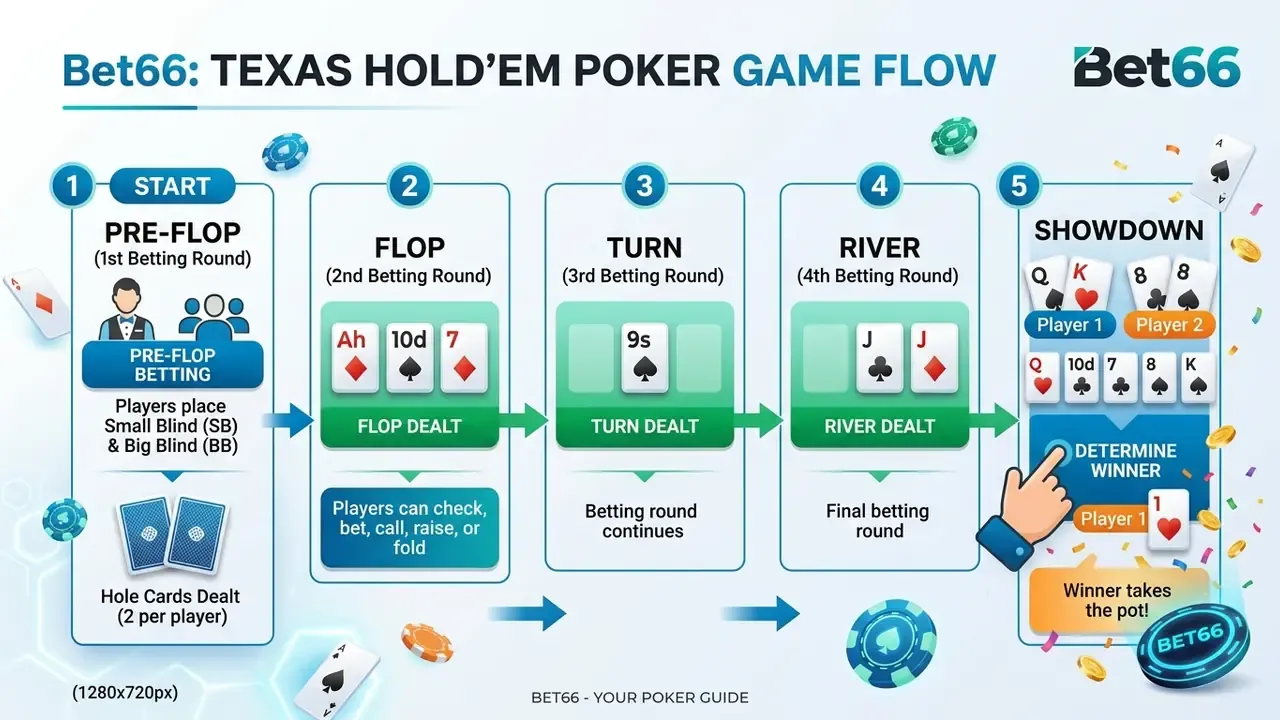
- Step 1: Forced Blinds. Small and Big Blinds are posted to establish the pot.
- Step 2: Pre-Flop. Each player receives two private hole cards; the initial betting round occurs.
- Step 3: The Flop. Three community cards are dealt face-up; second betting round.
- Step 4: The Turn. A fourth community card is dealt face-up; third betting round.
- Step 5: The River. The fifth and final community card is dealt face-up; final betting round.
- Step 6: Showdown. Active players reveal hands, and the best five-card combination wins the pot. If all but one player folds earlier, that player wins without a showdown.

How to Start Playing Online Poker: Demo vs Real Money
Getting started means choosing between play-money practice clients and regulated real-money environments. Beginners should test software interfaces and rule interpretations in demo mode before they even look at deposit options.
Safe navigation involves verifying regulatory compliance, software integrity and banking security. Because federal law restricts domestic real-money providers, Australian players should treat brand claims with real compliance caution. Enforcement here is active, not theoretical.
«In 2025, the Federal Court of Australia imposed penalties exceeding A$24 million on the operators of illegal poker services PPPfish, Shuffle Gaming and Redraw Poker.» — ACMA, Federal Court Enforcement Action (2025). https://www.acma.gov.au/articles/2025-11/federal-court-finds-online-poker-operators-breached-gambling-laws
Legal Notice: This information is general in nature and does not replace legal advice. Australian online gambling legislation is updated regularly, so check the current provisions of the Interactive Gambling Act 2001 before using any platform, and remember that offshore operators sit outside Australian consumer protections.
When to Choose Poker Demo Mode
Poker demo mode suits you when you are learning table controls, studying hand ranks or testing a new betting approach without capital exposure. Free platforms run the same dealing algorithms, minus the financial consequence.
Research on simulated gambling carries a warning that adult players and parents should weigh carefully.
«As adolescents mature, engagement with simulated gambling increases, and it is perceived as normal well before the risks are understood.» — Hing et al., Addiction Research & Theory (2023). https://www.tandfonline.com/doi/full/10.1080/16066359.2023.2207010
In practice, play-money games help users master complex interface mechanics and multi-stage betting flows. Still, opponents in demo modes call bets recklessly, which makes demo results an imperfect indicator of real-money behaviour. Access for minors should be restricted, since simulated products normalise gambling mechanics without any financial cost attached.
For Australian residents, compliant social platforms provide risk-free practice options:
- ClubGG:A private club-based application (iOS, Android, Windows) that lets players organise customised tournaments and social play using virtual tickets rather than cash balances. Handy for closed groups and community leagues.
- Replay Poker:A browser-based free-play platform with 24/7 Sit & Go events and Multi-Table Tournaments (MTTs), plus daily free chip refills and streak rewards. Financial exposure: zero.
- Australia Poker League (APL):Australia's largest grass-roots live poker organisation, running tiered events in pubs and clubs in every state. A natural progression path from free online software to live play.
- Casino and festival circuits:Australian venues host structured live series with varied formats, while many local players follow the World Series of Poker (WSOP) structures used internationally.

Pre-Requisites for Real-Money Play
Before entering any real-money game, audit the operational factors sitting behind the promotional banner. Verifying operator credentials reduces withdrawal friction and supports game fairness. The scale of the unlicensed market makes that due diligence non-negotiable.
«Between July and September 2024, ACMA identified 56 breaches of the IGA and referred 47 websites for blocking, most offering poker and other casino games.» — ACMA, Action on Interactive Gambling: July–September 2024. https://www.acma.gov.au/publications/2024-11/report/action-interactive-gambling-july-september-2024
- Licensing and regulatory compliance:Check whether the brand holds valid authorisation in a recognised jurisdiction, and confirm that RNG certification and audit reports are published, not merely claimed.
- Rake and fee structures:Inspect the percentage taken per pot and the maximum cap across cash games and tournaments. At micro-stakes, rake is often the single largest drag on results.
- Payment limits and times:Confirm minimum deposit rules, identity verification (KYC) requirements, currency conversion charges and withdrawal processing windows.
- AU-friendly banking and statutory restrictions (updated):Under the June 2024 updates to Australian wagering rules, licensed operations prohibit credit card and cryptocurrency transactions outright. Players comparing offshore or practice platforms often meet localised rails such as PayID, Apple Pay, Google Pay and digital e-wallets, and those choices directly influence payout speed and KYC processing time.
- Responsible gambling infrastructure:Look for active limit-setting tools, session timers, reality checks and self-exclusion mechanisms inside account settings.
- Game and traffic availability:Check that your preferred discipline actually runs during Australian peak hours (AEST, ACST, AWST evenings). Otherwise lobbies will look empty, whatever the platform's reputation.

Payment Methods and Withdrawal Times for Australian Players
Typical payment rails encountered by Australian players, restrictions and expected processing times
| Method | Status under Australian rules | Typical deposit speed | Typical withdrawal window | Key considerations |
|---|---|---|---|---|
| PayID / Osko | Widely used domestic rail for licensed wagering | Instant to minutes | Same day to 2 business days | Bank-linked identity; not offered by every offshore platform |
| Apple Pay / Google Pay | Permitted when funded by debit, not credit | Instant | Rarely supported for payouts | Deposit-only in most cases; withdrawals rerouted to bank transfer |
| Debit card / bank transfer | Permitted | Instant to 1 day | 1–5 business days | Slowest rail but most traceable; full KYC required |
| E-wallets (Skrill, Neteller, prepaid vouchers) | Availability varies by operator | Instant | 24–48 hours | Watch conversion fees and wallet-specific bonus exclusions |
| Credit cards | Prohibited for regulated online wagering since June 2024 | Not applicable | Not applicable | Any site accepting credit cards from Australians is a compliance red flag |
| Cryptocurrency | Prohibited for regulated online wagering since June 2024 | Minutes | Offshore rooms advertise 1–24 hours | No Australian consumer protection; volatility and irreversible transfers |
Because offshore rooms fall outside Australian jurisdiction, there is no domestic regulator to escalate a payment dispute to. Delays usually trace back to five triggers: repeat KYC requests, mismatched deposit and withdrawal methods, suspected multi-accounting, bonus-term breaches, or unverified source-of-funds documents. Keep deposit and withdrawal methods identical wherever possible; it removes the most common cause of a held payout.
Australian Tax Regulations on Poker Winnings
According to the Australian Taxation Office, gambling and poker winnings for recreational players are generally treated as tax-free incidental gains rather than assessable income. Australian residents playing for personal entertainment do not need to declare tournament or cash-game payouts on a personal tax return.
The picture changes for a systematic professional. Where the activity is structured as a regular business enterprise carried on for profit, winnings become taxable income and must be declared. Income derived from illegal gambling activity also remains taxable, while losses and expenses incurred through such activity cannot be claimed as deductions under statutory guidelines.

Tax disclaimer: This section is general information only and is not tax advice. Individual circumstances differ, so consult a registered tax agent or the ATO directly before treating poker income as business or hobby earnings.
How to Choose a Poker Casino and Evaluate the Offer
Evaluating a poker casino or promotion means reading the fine print, not the banner number. Real value depends on wagering requirements, game contributions, withdrawal caps and operator reputation. A 300% match with an unreachable playthrough is worth less than a modest offer you can actually clear.
Rigorous comparison separates legitimate entertainment platforms from restrictive offers. Independent evaluation frameworks, including those documented in our casino and poker platform reviews, put transparency, terms verification and support responsiveness ahead of promotional marketing.
A workable habit when comparing poker sites: shortlist three brands, then judge them on the same five points. Legal status for Australia. Bonus terms after wagering. Payment rails and payout window. Complaint history and how the operator responded. Traffic in your preferred variant. Whichever brand wins on the boring criteria usually wins over a full year of play too.

Poker Bonuses, Freerolls and Promotional Offers
- Welcome match bonuses:Match an initial deposit up to a fixed cap, usually released in increments as rake is generated rather than credited instantly. Headline figures such as «100% to 300% up to several thousand dollars» typically unlock in small tranches.
- No-deposit and daily chip bonuses:Common on social and free-play platforms, where login streaks release escalating virtual chip amounts (for example 500 chips rising to 2,500 chips by day five) or tournament tickets.
- Freeroll tournaments:Events with no buy-in that award real prizes or satellite tickets. The lowest-risk route into competitive structures.
- Tournament tickets:Direct access passes to scheduled events, granted through promotional codes or loyalty milestones.
- Rakeback and loyalty programs:Return a percentage of paid tournament fees or cash-game rake to your balance. Industry rates run from roughly 10% up to VIP tiers near 25% to 27%, which materially shifts long-run break-even points at low stakes.

[❓ QUIZ: Interactive checklist for evaluating a poker site offer and pre-deposit readiness. Caption: «Poker Casino Verification Criteria».]
- Regulatory status: Is the operator's legal information clearly displayed and independently verifiable?
- Bonus wagering terms: Are playthrough multipliers, excluded games, maximum stake rules and expiry dates realistic for your session volume?
- Game accessibility: Are your preferred variants (Texas Hold'em, PLO, 6+ Short Deck, Stud) actively hosted with real traffic during Australian evenings?
- Withdrawal transparency: Are daily and monthly payout caps, KYC procedures and source-of-funds requirements detailed before deposit?
- Rake caps: Is the rake structure and cap per pot competitive with industry standards?
- Payment compliance: Does the platform respect the June 2024 credit card and cryptocurrency restrictions that apply in Australia?
- Safer gambling tools: Are deposit limits, session timers and self-exclusion tools easy to configure in account settings?

Fact Check / Bonus Verification Note: Always audit official promotional terms on the operator's page before opting in. Check playthrough conditions (wagering multipliers), restricted game types, maximum stake rules while bonus funds are active, and cash-out limit clauses. Never assume promotional funds behave like cash, and never assume a bonus can be withdrawn before verification is complete.
Poker Strategy for Beginners
Sound poker strategy rests on probability, positional awareness, disciplined hand selection and bankroll control. Intuition is a nice extra, not a plan. Beginners who adopt structured decision-making reduce avoidable losses across long sessions, a principle reflected in our broader online gambling strategy guides, although the size of that improvement varies by player and stake level and would benefit from further published data.
Research into professional online play offers a deliberately sobering framing of long-term outcomes.
«Poker is 'typically associated with financial losses', and sustained long-term success is available only to a small minority with exceptional discipline.» — Newall & Talberg, Addiction Research & Theory (2023). https://www.tandfonline.com/doi/full/10.1080/16066359.2023.2195656
Put plainly: elite players achieve positive expectation through strict risk management and rigorous review, while the typical recreational participant loses money over time. Applying fundamentals is about reducing error and controlling cost, not manufacturing an income.
Situation: A beginner frequently lost chips by playing weak starting cards from early positions.
Action: We implemented a tight-aggressive positional chart limiting played hands from early seats while expanding aggression on the button.
Result: The player reduced pre-flop decision complexity and improved overall session stability over 500 simulated training hands.

Fundamental Strategy for Texas Hold'em and Tournaments
- Starting hand selection:Fold weak or unsuited disconnected cards before the flop. Premium pairs (A-A, K-K, Q-Q) and high connectors (A-K suited) form the core of a profitable pre-flop range.
- Positional advantage:Act last whenever you can. Players on the Button or Cutoff see opponent actions first, gathering information before committing chips.
- Stack management:Keep bankroll discipline. In cash play, avoid risking more than 2% to 5% of your total poker bankroll at a single table. In tournaments, adjust as blind levels rise relative to your stack, shifting from speculative hands to pressure-based shoving ranges as the stack shortens.
- Rake awareness:At micro-stakes, rake can eat most of a marginal edge. Confirm the rake percentage and cap per pot before grinding low limits, and factor rakeback into a realistic win rate.

Beginner starting-hand tiers (No-Limit Hold'em, full ring):
| Tier | Example hands | Recommended action |
|---|---|---|
| Premium | AA, KK, QQ, JJ, AKs | Raise from any position; re-raise confidently |
| Strong | TT, 99, AQs, AJs, KQs, AKo | Raise from middle or late position; proceed cautiously against early-position aggression |
| Speculative | 88–22, suited connectors (JTs, 98s), suited aces | Play in late position or multi-way pots with implied odds |
| Marginal | KJo, QTo, Ax offsuit, weak suited kings | Fold from early seats; use selectively as steals from the button |
| Fold | Offsuit disconnected low cards (J4o, 92o) | Fold irrespective of position |
Post-Flop Tactics: Check-Raising, Backdoor Flushes and Suited Connectors
- Post-flop check-raising:From early position, check to the initial aggressor, then raise their bet. Opponents holding weak continuation bets fold, and the pot is yours. This works best on boards that favour your perceived range.
- Leveraging backdoor flushes:A backdoor flush needs two runner-runner cards on Turn and River, which makes it a useful semi-bluffing candidate. It adds equity to aggressive lines on the flop and makes your range harder to read, because the same line can represent a completed draw later.
- Playing suited connectors:Hands such as 9-8 suited or J-T suited perform well in multi-way pots. High implied odds mean disguised straights and flushes can stack an overconfident top-pair opponent.
- Reading bluffing frequency:Uncertainty peaks straight after the flop, so well-timed aggression from the seat left of the big blind often wins uncontested pots. Also note which opponents bet large on every street. Their bluff frequency, not your hand strength alone, should decide whether you call.

Even flawless technical play collapses without emotional control. Extended losing streaks trigger tilt: impulsive raising, stake escalation, chasing losses. That is precisely the behavioural pattern that converts recreational play into financial harm, which makes psychological discipline the bridge between strategy and the safeguards described below.
FAQ: Poker Online in Australia
Responsible Real-Money Poker Play
Health disclaimer: This information is general in nature and does not replace advice from a problem-gambling specialist. If you notice signs of dependency, contact Gambling Help Online on 1800 858 858.
Responsible gambling means treating poker as a paid recreational activity, never an income source. Firm control over time and money spent is what prevents financial strain and personal harm.
In Australia, public health frameworks emphasise structural safer-play safeguards. The parliamentary committee report You win some, you lose more (2023) argues that harm prevention requires proactive limit-setting and objective self-awareness. Attitudinal research shows why uptake of these tools stays uneven.
«A survey of 2,603 regular online bettors found many perceive protective tools as intended only for 'problem gamblers', rather than as a universal measure.» — AGRC / AIFS, National Gambling Trends Study (2023). https://aifs.gov.au/resources/research-summaries/national-gambling-trends-study-online-betting-2023
Federal updates implemented in June 2024 ban credit cards and digital currencies for regulated online wagering, which removes borrowed money from the wagering cycle. National self-exclusion has also seen substantial uptake.
«In its first year of operation, BetStop recorded more than 28,000 registrations, almost half from users under 30, with around 40% choosing a lifetime exclusion.» — ACMA, BetStop First Year Data (August 2024). https://www.acma.gov.au/articles/2024-08/betstop-reaches-28000-registrations
International harm-reduction bodies frame the same message in plain financial terms: set limits on time and money, gamble only with money you can afford to lose, track your spend, and stop when a limit is reached.
Who should skip real-money poker entirely:
- Anyone under 18 years of age.
- Players carrying consumer debt, or who would need to borrow to fund a session.
- Anyone who has previously chased losses, hidden gambling spend, or escalated stakes after a downswing.
- Players experiencing acute stress, grief, substance use or impulse-control difficulties.
- Anyone treating poker as a fix for a financial shortfall rather than paid entertainment.

RESPONSIBLE GAMBLING ALERT: Real-money poker involves substantial financial risk and should never be treated as a reliable source of income or a way to clear debt. Set strict, non-negotiable limits on deposits, stakes and play duration before you start. If gambling stops feeling recreational, or begins causing financial stress, use support tools immediately.
Free, confidential support is available 24/7 in Australia via Gambling Help Online on
1800 858 858or at gamblinghelponline.org.au. Australian residents can also block access to all licensed online wagering providers through the national self-exclusion register, BetStop, at betstop.gov.au.